
B&O Railroad Museum: Baltimore's Monument to the Iron Horse
Where American Railroading Began
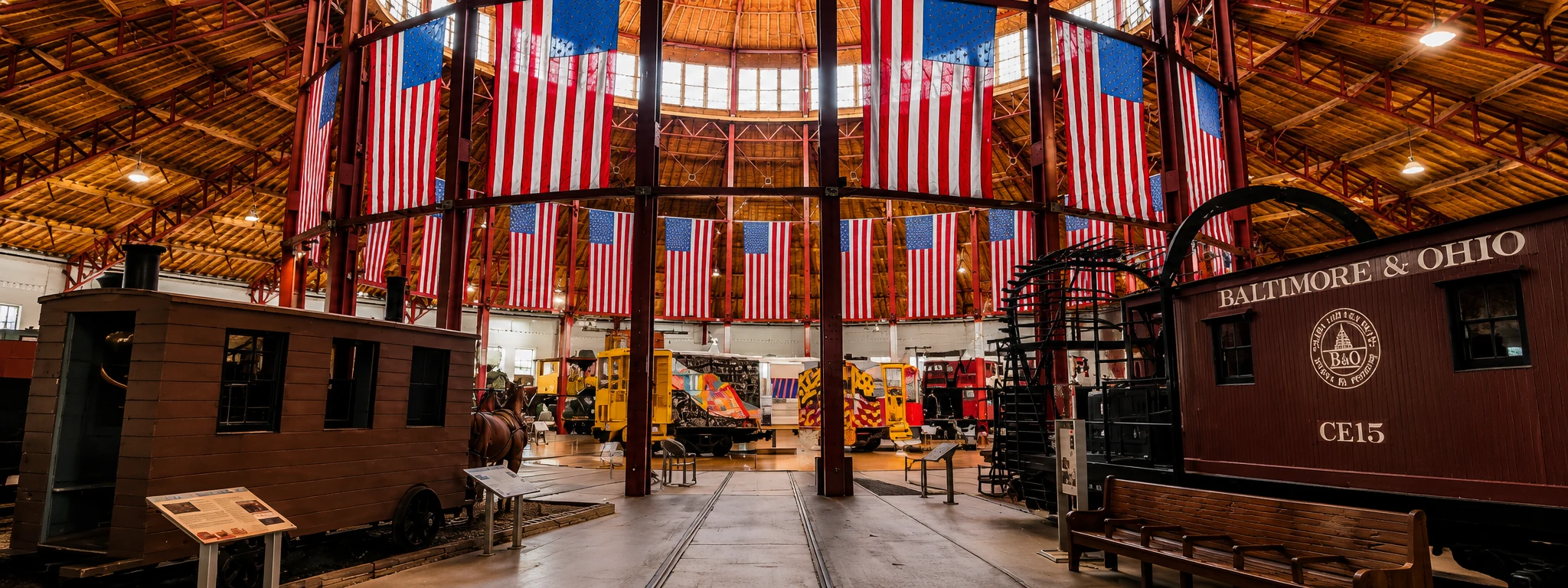
The roundhouse rises against the Baltimore sky like a cathedral dedicated to steam and steel. Inside this circular brick building, historic locomotives stand in silent testimony to the revolution that transformed America. The B&O Railroad Museum occupies the historic Mount Clare Station complex, the very ground where American railroading began in 1828. More than just a collection of old trains, this Baltimore landmark preserves the birthplace of a transportation network that connected the nation and fundamentally altered how Americans lived, worked, and understood distance itself.
Understanding the B&O Railroad Museum requires understanding why Baltimore needed a railroad in the first place. In the 1820s, Baltimore faced a crisis. The Erie Canal had just opened, giving New York a direct water route to the expanding western territories. Philadelphia had similar canal advantages. Baltimore, despite being one of America's largest cities and busiest ports, had no comparable transportation infrastructure connecting it to the inland markets that would determine future prosperity.
The Baltimore & Ohio Railroad Company was chartered in 1827 and broke ground on July 4th, 1828, with Charles Carroll, the last surviving signer of the Declaration of Independence, turning the first shovelful of earth. That symbolism was intentional. Baltimore's civic leaders saw the railroad as important to the young nation's future as independence itself had been.
The Mount Clare Shops, which now house the museum, opened in 1829 as the railroad's maintenance and construction facility. Here, workers built locomotives, designed rolling stock, and solved the countless practical problems that arose as they created something that had never existed before. Every achievement happened through trial and error. Every advance required innovation because there were no textbooks, no established practices, no experienced engineers to consult.
The Roundhouse and Its Treasures
The museum's centerpiece is the 1884 roundhouse, an architectural marvel in its own right. The circular building, 235 feet in diameter, was designed to efficiently service multiple locomotives simultaneously. Twenty-two radiating tracks converge on a central turntable, allowing engines to be rotated and positioned at any of the servicing bays. The roof soars overhead, supported by iron columns and massive timber trusses, creating a space that feels more like a palace than an industrial facility.
Walking into this space for the first time creates an immediate impression of scale and power. Historic locomotives, some dating back to the earliest days of railroading, sit on the radiating tracks like crown jewels displayed in a treasury. Each represents a different era, a different technological approach, a different vision of what railroads could be.
The museum doesn't just display these machines behind velvet ropes. Well-designed interpretive materials explain how each locomotive worked, why it was designed the way it was, and what role it played in railroad operations. Interactive elements let visitors understand technical concepts like how steam engines convert heat into motion or how air brakes revolutionized railroad safety.
Beyond the Roundhouse
The museum complex extends beyond the roundhouse to include several other historic structures. The Mount Clare Station building, completed in 1851, is the oldest railroad station in America. The elegant Italianate design demonstrates how railroads quickly evolved from purely utilitarian enterprises to institutions concerned with public image and customer experience. The station now houses exhibits about early passenger travel and the social impact of railroads.
The Annex building contains additional exhibits exploring specialized topics: railroad signaling systems, the role of railroads in wartime, the economic impact of rail transportation, and the daily lives of railroad workers. These exhibits provide context that helps visitors understand railroads as complex systems rather than just impressive machines.
Outside spaces include an operational track where vintage trains carry passengers on short rides, giving visitors, especially children, the thrill of actually experiencing railroad travel on historic equipment. The museum owns several operational locomotives and cars that they carefully maintain for these demonstration runs. The experience of riding even a short distance behind a steam locomotive, hearing the whistle, feeling the motion, and smelling the coal smoke, creates memories and understanding that static displays cannot match.
Railroad History as American History
The story told at the B&O Railroad Museum is fundamentally the story of how America developed. Railroads didn't just respond to growth; they caused it. Towns existed or died based on whether the railroad came through. Industries located themselves along rail lines. Agricultural markets expanded because farmers could ship produce quickly to distant cities. People moved west in unprecedented numbers because railroads made the journey survivable.
The role of railroads in Baltimore's development threads throughout the museum. The city grew dramatically during the railroad era, with industries clustering along rail lines and workers building neighborhoods within walking distance of railroad employment. Understanding this history helps visitors understand why Baltimore looks the way it does, why certain neighborhoods developed where they did, and why particular industries became important to the city's economy.
Engaging Experiences for All Ages
The B&O Railroad Museum excels at creating experiences that work for visitors with different interests and backgrounds. Train enthusiasts can spend hours examining technical details, reading equipment specifications, and photographing rare locomotives. Families with young children find interactive play areas, the train rides, and child-focused programs that make railroad history accessible and fun.
Model railroad layouts throughout the museum demonstrate how railroads operated as systems. These intricate miniature railroads, some covering hundreds of square feet, show how yards worked, how trains were assembled and dispatched, and how the various specialized cars and equipment functioned together. The level of detail in these layouts is extraordinary, and watching them operate helps visitors understand railroad operations in ways that static displays cannot convey.
The museum shop offers an impressive selection of railroad books, models, memorabilia, and Baltimore-specific items. For serious railroad enthusiasts, the selection of technical and historical books is particularly strong, including rare and specialized titles difficult to find elsewhere.
Preservation Work and Living History
Behind the scenes, the B&O Railroad Museum engages in ongoing preservation and restoration work. Historic locomotives require constant care to prevent deterioration. Skilled craftspeople maintain these artifacts using traditional techniques and materials, keeping alive knowledge that would otherwise disappear as the people who worked on steam locomotives pass away.
The museum occasionally undertakes major restoration projects, bringing long-neglected equipment back to displayable condition. These projects can take years and require specialized expertise. The museum often provides viewing access to restoration work in progress, letting visitors see the painstaking process of preserving railroad history.
As a research institution, the museum maintains extensive archives of railroad documents, photographs, technical drawings, and artifacts. Researchers from around the world use these collections to study railroad history, and the museum's staff actively contributes to scholarship about railroads and their impact.
Visiting Baltimore's Railroad Cathedral
The B&O Railroad Museum is located at 901 West Pratt Street in Baltimore, in the Southwest Baltimore neighborhood. The area has faced economic challenges, but the museum stands as an anchor institution working to preserve history while contributing to community revitalization.
Getting to the museum is straightforward by car, with parking available on site. The Light Rail's Hamburg Street station sits within walking distance, offering a fitting way to arrive at a railroad museum. Several bus lines also serve the area. From the Inner Harbor, the museum is about a mile west, an easy walk for those who enjoy urban exploration.
The B&O Railroad Museum does more than preserve old trains. It maintains the memory of an era when Baltimore stood at the forefront of American innovation, when the city's vision and determination helped create the infrastructure that made modern America possible. Walking through the roundhouse, standing beside these enormous machines, imagining the workers who built and maintained them, you connect with a particular American confidence that believed no challenge was too great, no distance too vast, no problem unsolvable. That spirit, born in Baltimore nearly two centuries ago, remains worth preserving and celebrating.
Driving/Walking Directions From A-Plus IT Group, Inc | Managed IT Services and IT Support Company in Baltimore | Local IT Company in Baltimore to B&O Railroad Museum
Driving Directions to Baltimore Museum of Art